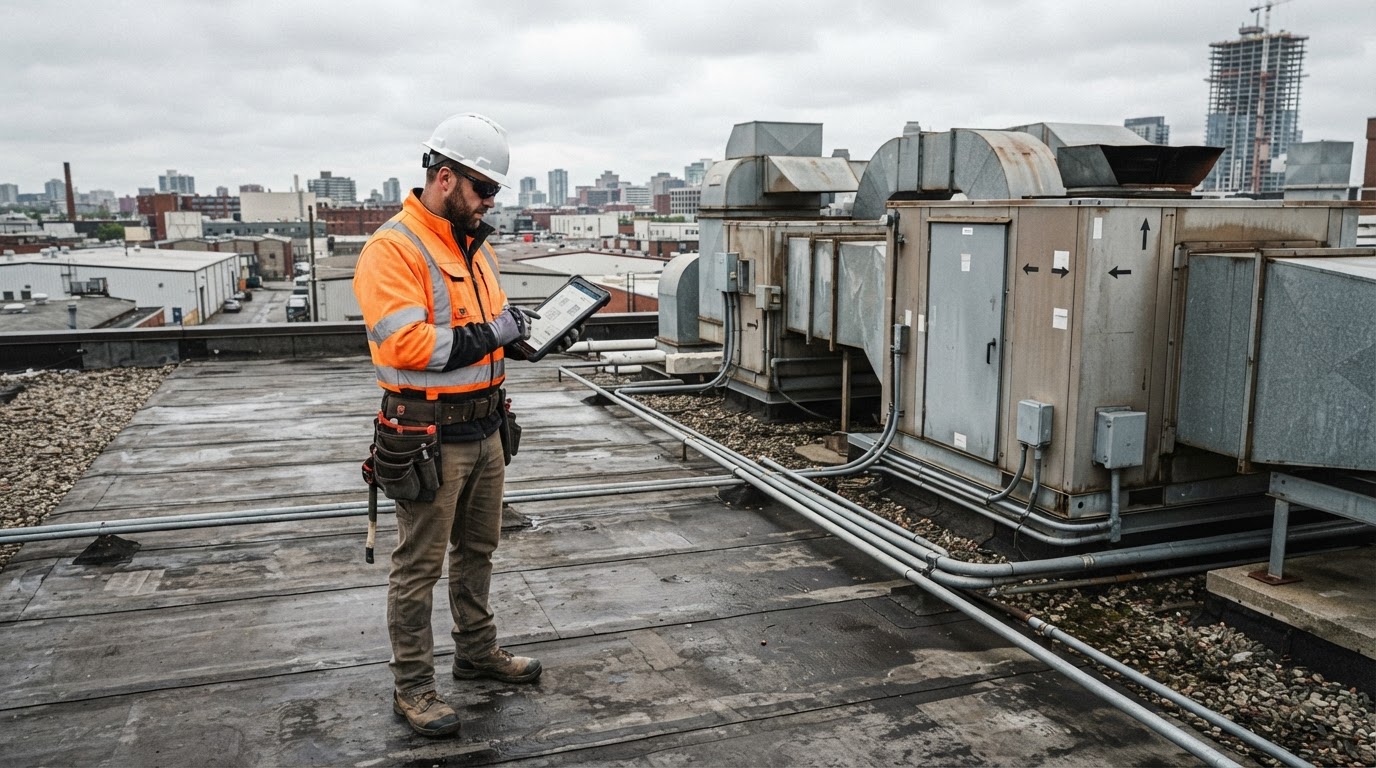
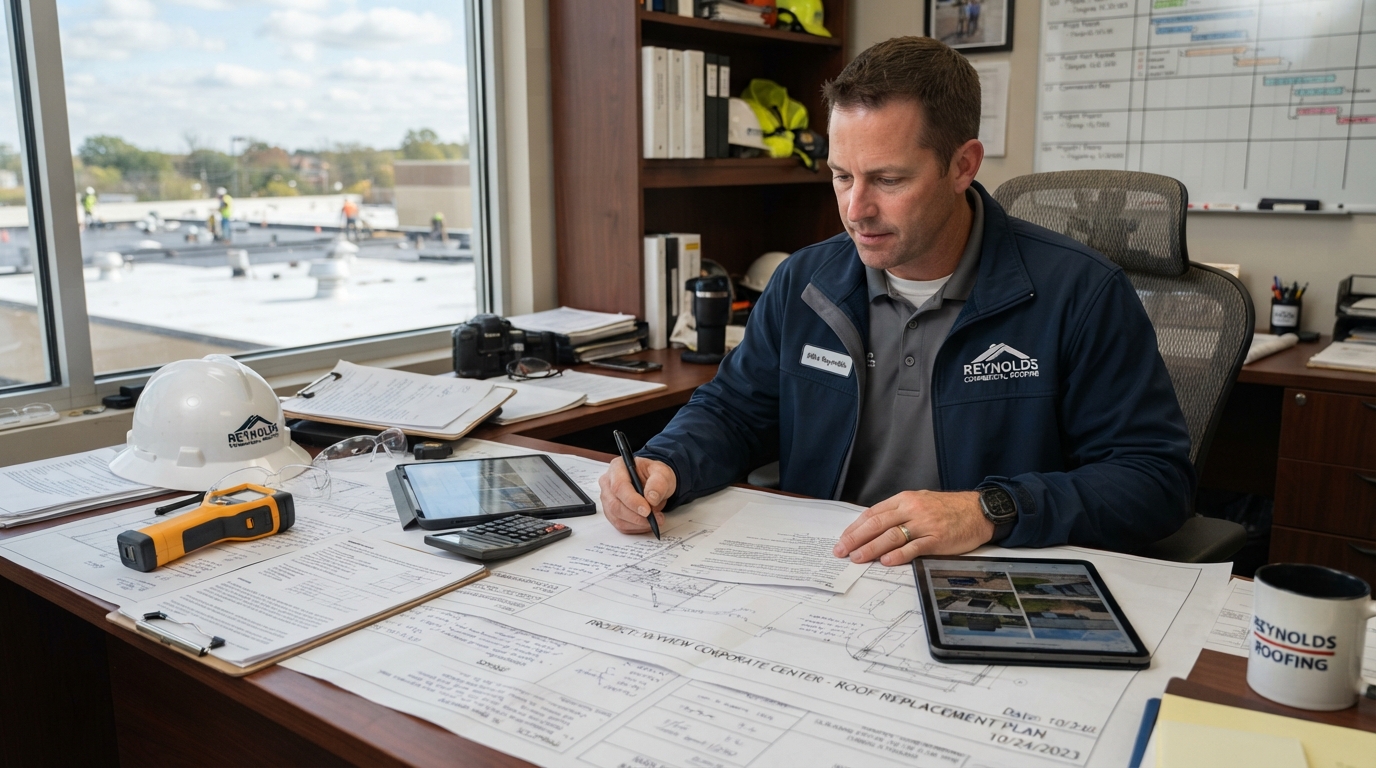
Your team spent two hours on the roof, took measurements, documented the condition of the membrane, and prepared a detailed proposal for a flat roof replacement. You sent it to the property manager. They said they would review it with the building owner. Two weeks pass. You call. They say they are still reviewing. Another week passes. You assume they went with another company and move on.
This scenario plays out in commercial roofing companies every day. The bid was strong. The inspection was thorough. But the follow-up was inconsistent, and the opportunity faded. This guide explains how commercial roofing companies can follow up on bids and proposals after inspections — keeping estimates visible, coordinating decision-makers, and knowing when to stop. For a broader lead generation and follow-up system, see our commercial roofing growth system.
Why Most Roofing Bids Go Cold
Commercial roofing bids have long decision cycles. A property manager receives your proposal, but they are not the only decision-maker. They need to review it with the building owner, who may need to discuss it with a board or a corporate office. The proposal sits in an inbox while these conversations happen — and if nobody follows up, it gets buried under the next urgent task.
The problem is not that your bid was uncompetitive. The problem is that your business is one of several proposals the property manager is juggling, and the one that follows up consistently stays top of mind. Without a system, follow-up depends on memory — and memory fails when your team is busy doing the actual roofing work.
The Follow-Up Gap After Inspections
The inspection is where the relationship starts. Your team walks the roof, documents the condition, and builds trust with the property manager. But the time between the inspection and the decision is where most opportunities stall.
During this gap, several things happen:
- The property manager gets busy with other buildings and forgets to review your proposal
- A competitor sends a lower bid and follows up more aggressively
- The building owner asks questions the property manager cannot answer without coming back to you
- Weeks pass and the sense of urgency fades
A consistent follow-up process keeps your proposal visible during this gap. It does not guarantee a contract — but it ensures your bid is not forgotten simply because nobody followed up.
Useful Cadence Principles
Follow-up cadence is about timing, not volume. Too many messages feel pushy. Too few and you are forgotten. Here is a practical cadence that works for commercial roofing bids without promising results:
**First check-in (2–3 days after sending the proposal):** A brief message asking if the prospect has had a chance to review the proposal and whether they have any questions. This is not a sales push — it is a helpful nudge.
Example: "Hi [Name], just following up on the roof replacement proposal we sent for [Property]. Have you had a chance to review it? Happy to answer any questions about the scope or timeline."
**Value reminder (7–10 days after sending):** A message that adds value rather than just asking for a decision. Reference something specific from the inspection — a condition you noted, a recommendation you made — to show you understand their building.
Example: "Hi [Name], I was thinking about the membrane condition we documented during the inspection at [Property]. The area near the HVAC units will need attention first to prevent further ponding. Let me know if you'd like to discuss the phased approach we included in the proposal."
**Decision check (14–21 days after sending):** A direct but respectful message asking where the prospect stands. Are they still evaluating, have they made a decision, or do they need additional information?
Example: "Hi [Name], checking in on the proposal for [Property]. Are you still in the evaluation phase, or is there anything else we can provide to help with the decision? We're happy to adjust the scope or timeline if needed."
**Final touch (30 days):** If there has been no response, one final message acknowledging that you understand they may have gone in a different direction, and leaving the door open.
Example: "Hi [Name], I haven't heard back on the proposal for [Property], so I imagine you may have gone another direction. If anything changes or you need a second opinion, we're here. Thanks for the opportunity to inspect the roof."
These are example messages, not a guarantee of outcomes. Actual results vary based on the prospect, the market, and the competitiveness of your bid.
Coordinating Multiple Decision-Makers
In commercial roofing, the person you send the proposal to is rarely the only decision-maker. A property manager may need approval from a building owner, who may need to consult a board, a corporate office, or a tenant association. This multi-layered decision process is one of the main reasons bids go cold.
To coordinate effectively:
- Ask who is involved in the decision during the inspection or when sending the proposal. Knowing the decision chain helps you understand the timeline.
- Offer to present to the full decision-making group if that would help. A 15-minute walkthrough of your proposal can answer questions that emails cannot.
- Provide materials the property manager can share — a one-page summary, photos from the inspection, or a scope breakdown that makes it easy for them to advocate for your bid internally.
- Respect the process — do not try to bypass the property manager to reach the building owner directly unless invited. That can damage the relationship.
Stop on Reply
One of the most important principles of automated bid follow-up is simple: stop the automated sequence the moment the prospect replies. Once a human is engaged in the conversation, automated messages should pause and let your team take over.
If the prospect replies with a question, your team answers it personally. If they say they need more time, the automated sequence pauses and your team follows up manually when appropriate. If they say they went with another company, the sequence stops and you thank them for the opportunity.
Continuing to send automated messages after a prospect has replied feels impersonal and can damage your credibility. The system should be smart enough to detect a reply and hand off immediately.
Tracking Bid Outcomes
Without tracking, you are guessing. A simple bid tracking system records:
- Date proposal sent — so you know how long each bid has been outstanding
- Follow-up messages sent — which messages, on what dates
- Prospect responses — what they said, if anything
- Outcome — won, lost, postponed, or no response
- Reason for loss (if known) — price, scope, timing, or competitor
Over a few months, this data tells you which follow-up timing works best, which types of proposals win most often, and where your process is breaking down. You can see how we track similar metrics on our results page.
When to Use Automation vs. Personal Follow-Up
Not every bid should get the same follow-up process. Smaller repair quotes may need a single check-in. Large replacement projects with long decision cycles benefit from a multi-step sequence. Here is a practical framework:
- Small repair quotes ($1,000–$10,000): One personal check-in after 3–5 days. If no response, one follow-up after 10 days. Then move on.
- Mid-size projects ($10,000–$50,000): A 3-step sequence over 21 days — check-in, value reminder, decision check. Personalize each message based on the inspection.
- Large projects ($50,000+): A longer sequence over 30–45 days. Include a offer to present to the decision-making group. Personal follow-up is essential for these.
Automation can handle the timing and reminders, but the content of each message should reflect the specific project and property. Generic follow-up messages feel impersonal. Referencing the inspection, the building, and the specific scope shows you are engaged.
Implementation Checklist
Before implementing a bid follow-up system, confirm you have the following:
- Your bid stages are defined (proposal sent, reviewing, decision made, won/lost)
- Follow-up message templates are written for each stage
- Timing and intervals between messages are configured
- Your team is trained on when to take over conversations personally
- The system stops automated messages when a prospect replies
- A tracking system records bid outcomes and follow-up activity
- Compliance with messaging regulations has been reviewed for your markets
30-Day Rollout Plan
**Days 1–7: Define your process.** Map your bid stages, write message templates, and decide which types of bids get automated follow-up vs. personal-only follow-up.
**Days 8–14: Set up the system.** Configure the follow-up sequence in your CRM or automation tool. Connect your pipeline so bid status updates when a prospect responds. Test the stop-on-reply logic.
**Days 15–21: Soft launch.** Apply the follow-up sequence to 3–5 active bids. Monitor responses and adjust messaging. Train your team on the handoff process.
**Days 22–30: Review and refine.** Look at the first two weeks of data. Which messages got replies? Which bids moved forward? Adjust the cadence and messaging based on what you learn.
Keep Your Bids Moving
Most commercial roofing bids are not lost on price — they are lost on follow-up. A consistent, respectful follow-up process keeps your proposal visible during the long decision cycle without being pushy. It does not guarantee a contract, but it ensures your bid is not forgotten simply because nobody followed up.
Brainify Digital builds and manages automated bid follow-up systems for commercial roofing companies — including message writing, pipeline tracking, stop-on-reply logic, and compliance review. Get your free lead-loss audit to find out where bids and proposals are slipping away, or learn about our commercial roofing growth system for a broader approach.