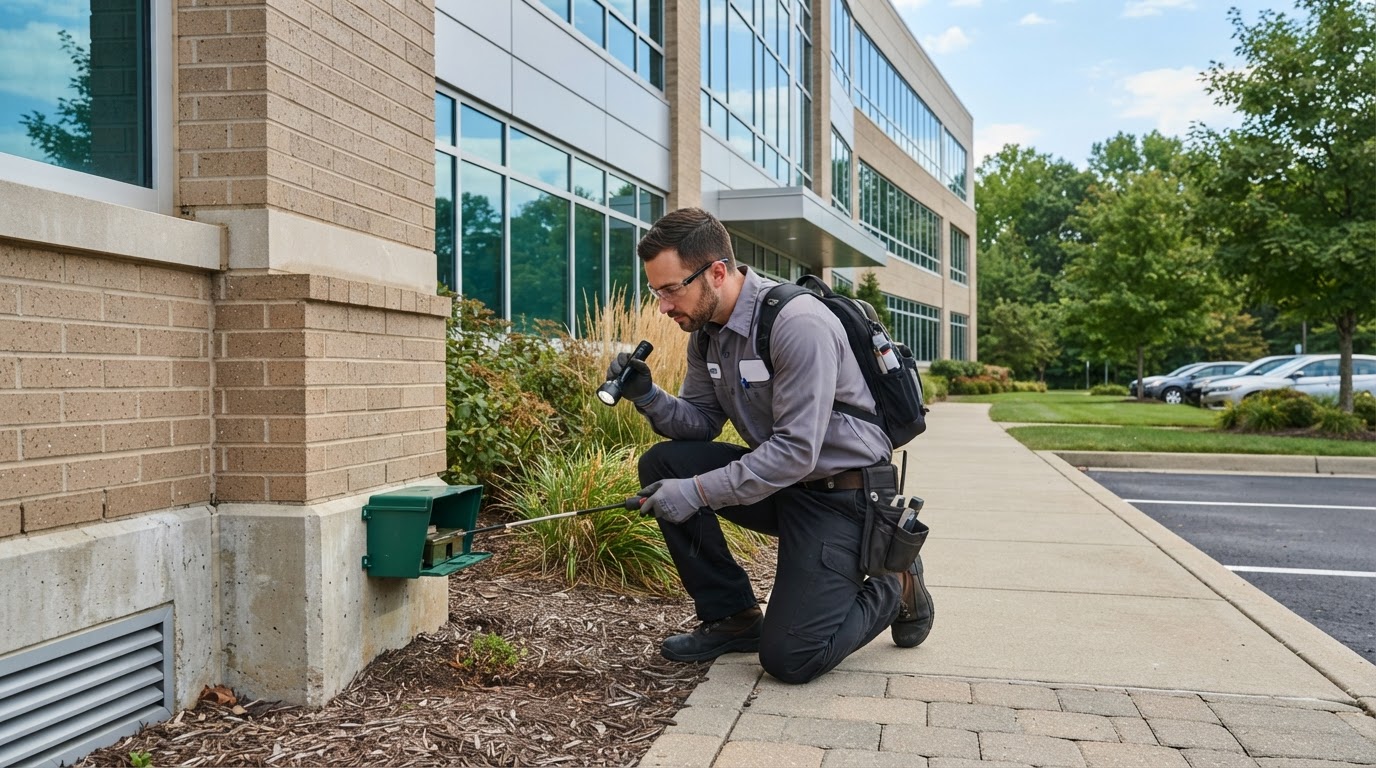
A property manager at a retail center notices rodents near the dumpster enclosure. They search "commercial pest control near me," call two companies, and book an inspection with whoever responds first. A restaurant manager sees cockroaches in the kitchen and needs treatment that same day. They call three pest control companies and hire whoever can be there within hours. A facility manager for a multi-location office portfolio needs a recurring pest management program. They email four companies and compare proposals.
Commercial pest control is an urgency-driven business. When a prospect calls, they need help now — or they need a structured recurring program. Either way, the company that responds fastest and most professionally usually wins. This guide walks through a practical lead follow-up system for commercial pest control companies — covering response speed, qualification, inspection scheduling, quote follow-up, recurring contracts, human handoff, and CRM pipeline stages — with sample messages and a 30-day rollout plan.
The Speed Expectation in Commercial Pest Control
Unlike many commercial services, pest control inquiries often carry genuine urgency. A restaurant cannot operate with visible pests. A property manager cannot ignore tenant complaints. A warehouse cannot risk product contamination. When these buyers call, they expect a fast response.
What "Fast" Means
- Emergency inquiries (active infestation at a food facility): Respond within minutes if possible, schedule same-day inspection.
- Urgent inquiries (tenant complaint, sighting reported): Respond within hours, schedule inspection within 24–48 hours.
- Recurring program inquiries (facility manager seeking a contract): Respond same day, schedule a site assessment within the week.
Your follow-up system should distinguish between these urgency levels and respond accordingly. A one-size-fits-all approach either over-responds to planning-stage inquiries or under-responds to emergencies.
Qualifying Property Type and Urgency
Not every pest control inquiry is the same. Qualifying early helps you prepare the right response, the right technician, and the right quote.
Key Qualification Questions
- What type of property is it? (Restaurant, retail, warehouse, office, multi-family, medical)
- What is the pest issue? (Rodents, cockroaches, termites, bedbugs, wildlife, general prevention)
- How urgent is it? (Active problem, preventive, planning a recurring program)
- Is this a single location or multiple sites?
- Who is the decision-maker? (Property manager, facility director, owner)
A simple intake process — whether handled by a person, a form, or an automated system — collects this information before you invest time in a site visit or a proposal.
Sample Qualification Text
"Hi, this is [Company Name]. Thanks for reaching out about pest control for your property. To help us prepare the right plan, could you text us: the type of property, the pest issue, and how soon you need service? We will get back to you within the hour with next steps."
Scheduling Inspections Efficiently
Most commercial pest control contracts start with an inspection. The faster you can schedule it, the more likely you are to win the account.
Inspection Scheduling Workflow
- 1Acknowledge the inquiry — Confirm receipt immediately by text or email.
- 1Qualify — Collect property type, pest issue, and urgency.
- 1Offer inspection times — Present two or three available time slots rather than asking "when works for you?"
- 1Send confirmation — Text or email the confirmed date, time, and what to expect during the inspection.
- 1Reminder — Send a reminder the day before the inspection.
This workflow reduces back-and-forth scheduling and makes it easy for the prospect to say yes. The same automated scheduling approach that works across commercial service businesses applies here — reduce friction at every step.
Quote Follow-Up After Inspection
After the inspection, you send a quote. Then what happens? For many pest control companies, the quote goes out and follow-up is inconsistent. The prospect receives multiple proposals. Days pass. The opportunity goes cold.
Quote Follow-Up Sequence
- 1Day 1 (Email): Send the proposal with a clear summary of findings, recommended treatment, pricing, and next steps. Offer to walk through it by phone.
- 1Day 2 (SMS): "Hi [Name], following up on the pest control proposal for [property]. Any questions? Happy to walk through it."
- 1Day 5 (Email): "Wanted to check in on the proposal for [property]. We can adjust the treatment plan or pricing if needed. What questions can I answer?"
- 1Day 10 (SMS): "Hi [Name], is the pest control service for [property] still moving forward? We can hold the proposed pricing through [date]."
- 1Day 14 (Email): "Following up one more time on the proposal for [property]. If timing has changed, let me know and we can revisit. If you have chosen another provider, no worries — we are here if you need us in the future."
This sequence is not about pressure. It is about making it easy for the prospect to say yes, ask a question, or tell you the project is on hold. Consistency matters more than frequency.
Multi-Location Accounts
Multi-location accounts are some of the most valuable opportunities in commercial pest control. A restaurant chain, a retail portfolio, or a property management company with multiple buildings represents recurring revenue across many sites.
Follow-Up for Multi-Location Opportunities
- Acknowledge scope — Confirm you understand it is a multi-location account and that you can serve all locations.
- Propose a coordinated program — Offer a single point of contact, consistent scheduling, and unified reporting across sites.
- Follow up with all decision-makers — Multi-location accounts often involve multiple stakeholders. Keep all of them informed.
- Be patient but persistent — These decisions take longer. Extend your follow-up timeline but do not go silent.
Recurring Service Agreements
The real revenue in commercial pest control comes from recurring contracts — monthly, quarterly, or seasonal service agreements. Your follow-up system should aim to convert one-time treatments into ongoing programs.
Transitioning One-Time to Recurring
After completing a one-time treatment:
- 1Day 1 (SMS): "Hi [Name], glad we could address the issue at [property]. To prevent recurrence, we recommend a quarterly program. Want me to send details?"
- 1Day 3 (Email): "Here is a recurring service plan for [property]: [details]. This includes scheduled visits, monitoring, and priority emergency response. Let me know if you would like to set this up."
- 1Day 7 (SMS): "Hi [Name], I can hold the quarterly rate for [property] through [date]. Want me to lock in the schedule?"
Human Handoff
Automated follow-up handles the repetitive work — acknowledgments, reminders, quote follow-ups, recurring-service prompts. But at key moments, a human needs to take over:
- Complex or sensitive accounts — Large multi-location contracts deserve a personal call.
- Pricing negotiations — If the prospect pushes back on price, a human conversation builds trust.
- Service issues — If a treatment did not resolve the problem, a personal follow-up shows accountability.
- Contract signing — Automated sequences can nurture, but closing the contract often requires a conversation.
Define clear handoff rules: when does an automated sequence stop and a person take over? Document these rules so your team knows when to step in.
CRM Pipeline Stages
A simple pipeline helps you see where opportunities are and where they are stalling.
Suggested Stages
- New Inquiry — Initial contact received
- Qualified — Property type, urgency, and scope confirmed
- Inspection Scheduled — Site visit booked
- Inspection Complete — Findings documented
- Proposal Sent — Quote delivered
- Follow-Up Active — Sequence running
- Contract Won — Service agreement signed
- Recurring Active — Ongoing service in place
- Lost — Opportunity closed (track the reason)
Track the source of each lead, the stage it reaches, and how long it stays there. Over time, patterns emerge: maybe inspection-to-proposal takes too long, or recurring conversion is lower than expected. This data helps you improve. See the results we track for examples of what to measure.
Responsible Messaging and Opt-Outs
When sending SMS or email follow-up, follow responsible practices:
- Identify your business — Every message should clearly state your company name.
- Honor opt-outs — If a prospect replies "STOP" or unsubscribes, remove them from the sequence immediately.
- Avoid excessive messaging — Three to five messages across two weeks is reasonable. Daily messages are not.
- Do not use deceptive urgency — Be honest about timelines and pricing.
- Obtain professional guidance where regulations apply — Messaging regulations vary by jurisdiction. This guide provides general best practices, not legal advice. Consult a qualified professional for compliance requirements.
30-Day Rollout Plan
**Week 1: Response and Qualification**
- Set up missed-call text-back with pest-control-specific messaging.
- Define your qualification questions and integrate them into your intake.
- Create urgency-based response rules (emergency, urgent, recurring).
**Week 2: Inspection and Proposal**
- Build your inspection scheduling workflow with confirmation and reminders.
- Create your proposal template with clear findings, treatment plan, and pricing.
- Set up your quote follow-up sequence (email + SMS).
**Week 3: Recurring and Pipeline**
- Build your one-time-to-recurring transition sequence.
- Configure CRM pipeline stages.
- Begin tracking lead source and stage duration for every opportunity.
**Week 4: Review and Refine**
- Review two weeks of pipeline data. Where are opportunities stalling?
- Adjust follow-up timing or messaging based on what you see.
- Ask two recent clients for reviews on Google.
Implementation Checklist
- [ ] Missed-call text-back active and branded for pest control
- [ ] Qualification questions defined and integrated
- [ ] Urgency-based response rules documented
- [ ] Inspection scheduling workflow with confirmations and reminders
- [ ] Proposal template created
- [ ] Quote follow-up sequence built and tested
- [ ] One-time-to-recurring transition sequence active
- [ ] CRM pipeline stages configured
- [ ] Lead source tracking active
- [ ] Opt-out handling verified
- [ ] Human handoff rules documented
Getting Started
Lead follow-up for commercial pest control companies is not about sending more messages. It is about responding at the right speed, qualifying intelligently, following up consistently, and guiding every opportunity from inquiry to signed service agreement. The companies that win are not always the biggest — they are often the ones who respond first, communicate clearly, and make it easy for property managers to say yes.
If you want help building and managing this system, explore our automation capabilities, review the results we track, browse our service areas, or contact us to request a Free Lead-Loss Audit and see where pest control opportunities may be slipping through the cracks in your current process.