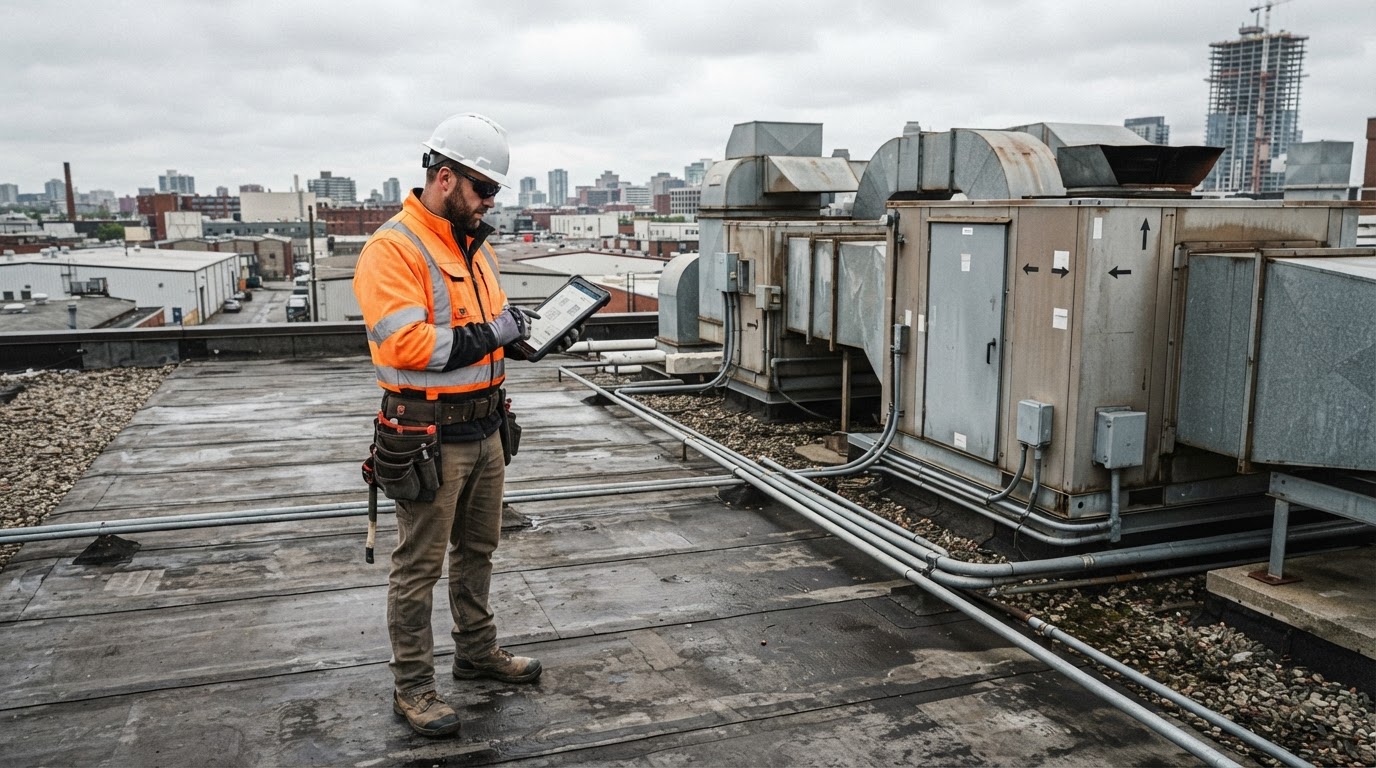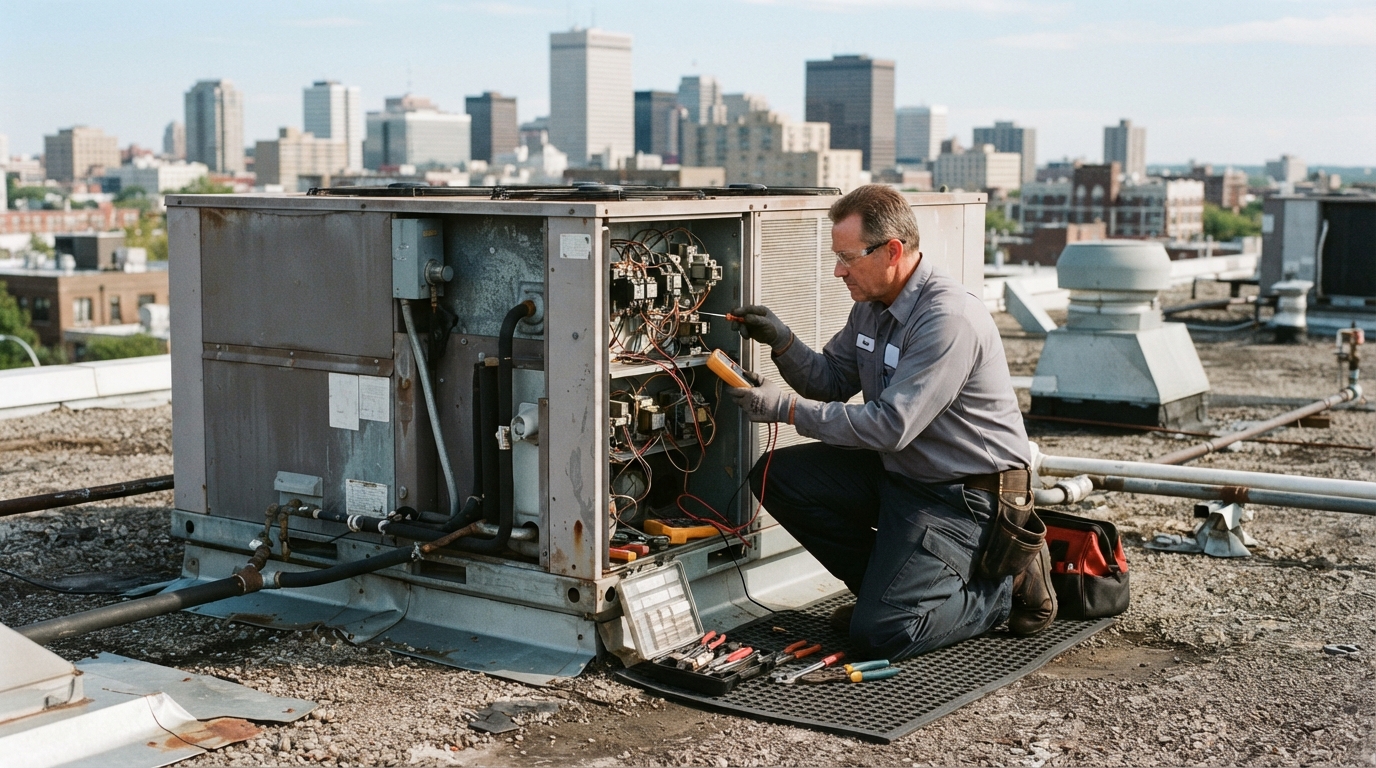
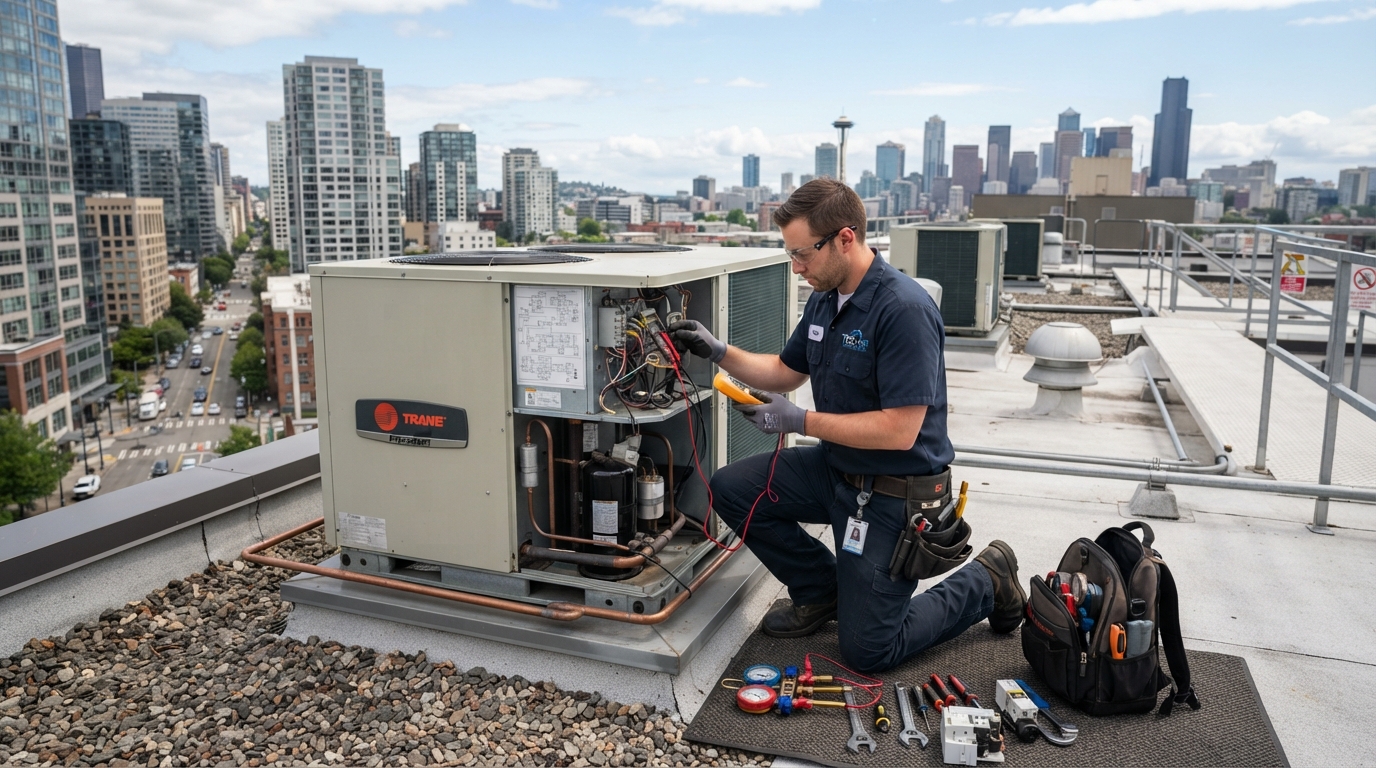
A facility manager at a medical office building notices the air conditioning is not keeping up on a Tuesday afternoon. They search for a commercial HVAC company, find your number, and call. Your entire team is on a rooftop across town. The call goes to voicemail. The facility manager does not leave a message — they call the next company on the list.
This is one of the most common and most expensive leaks in a commercial HVAC business. Your team is busy doing the work, and the calls that come in while they are on a job site go unanswered. This guide explains how missed-call text-back can help your commercial HVAC business respond to missed calls, recover after-hours and field-team quote requests, and hand off opportunities to your team without losing them. For a broader marketing and follow-up system, see our commercial HVAC growth system.
Why HVAC Teams Miss Calls
Commercial HVAC companies miss calls for two main reasons — and both are tied to the nature of the work.
**Field-team situations** are the first. When your technicians are on a rooftop, in a mechanical room, or driving between job sites, they cannot answer the phone. If your office has a dispatcher, that person may be on another call or stepping away for a moment. The result: a facility manager calls and nobody picks up.
**After-hours calls** are the second. HVAC emergencies do not respect business hours. A property manager calls at 6 AM about a system that stopped overnight, or at 9 PM about a building that is too hot for tenants. Your office is closed. The call goes to voicemail. Most commercial prospects do not leave a message — they move on to the next company that answers.
In both situations, the missed call represents a real opportunity: a service call, a maintenance contract, or a bid request. Text-back messaging gives you a second chance to capture it.
How Missed-Call Text-Back Works for HVAC
The system is simple. When a call to your business number goes unanswered, an automatic text message is sent to the caller within seconds. The message identifies your business, acknowledges the missed call, and invites the caller to share what they need.
Example — business hours text:
"Hi, this is [Company Name]. Sorry we missed your call! Our team is on a job site but we want to help. Are you calling about a repair, maintenance, or a new project? Reply here and we'll get right back to you."
Example — after-hours text:
"Hi, this is [Company Name]. Our office is closed, but we received your call. If this is an HVAC emergency, call our emergency line at [number]. Otherwise, let us know what you need and we'll follow up first thing in the morning."
The prospect receives an immediate response even though no human answered. They know their call was received and someone will follow up. This keeps the opportunity alive while your team finishes the job they are on.
Qualifying the Caller Through Text
A good text-back message does not try to qualify the prospect entirely through SMS. It asks one simple question or offers one clear next step. The goal is to gather just enough information to route the lead and start a helpful conversation.
For commercial HVAC, useful qualifying information includes:
- Service needed — repair, maintenance, replacement, or new installation
- Building type — office, retail, warehouse, medical, multi-tenant
- Urgency — emergency, scheduled service, or planning ahead
- Location — is the property within your service area?
- Best time to speak — when can your team call back?
The system can ask for this information in a short, conversational way. If the caller replies with details, your team receives a notification with the full conversation and can call back prepared.
After-Hours and Emergency Calls
HVAC emergencies need careful handling. A text-back message for an after-hours emergency should acknowledge the urgency and provide a clear path to reach a human quickly.
Example — emergency after-hours text:
"Hi, this is [Company Name]. If you have an active HVAC emergency (no cooling, system down, or safety concern), please call our emergency dispatch line now: [number]. We have technicians available for urgent calls. If it is not an emergency, reply here and we will follow up during business hours."
The text-back does not replace your emergency procedures. It bridges the gap so the caller knows their call was received and has a clear next step instead of hanging up and calling a competitor.
When Human Handoff Is Needed
Text-back works best when it creates a smooth handoff to a real person. The system should notify your team when a caller replies, include the full conversation context, and allow your team to take over or call the person directly.
Situations that always require human handoff include:
- Active emergencies — a building with no cooling in summer or no heating in winter needs a person, not a text
- Complex diagnostic questions — the caller wants to describe a problem in detail and get a professional opinion
- Bid or project requests — a property manager wants to discuss a multi-building replacement project
- Frustrated or confused callers — if the caller seems upset or unclear, a human should take over
The text-back message should make the handoff seamless. Your team sees the original missed call, the automated text, and the caller's reply in one place. When they call back, they can reference the conversation naturally without asking the caller to repeat themselves.
Compliant Follow-Up Practices
Text-back messaging is subject to telecommunications and consumer protection regulations. This section provides general guidance, not legal advice. For specific compliance questions, consult a qualified professional.
- Identify your business — Every text should clearly state your company name so the recipient knows who is messaging them.
- Honor opt-outs immediately — If a recipient replies "STOP" or asks to be removed, stop all further messages without delay.
- Keep messages concise — One initial text and one follow-up is a reasonable maximum for a missed call. Avoid flooding the caller with repeated messages.
- Avoid promotional language in the first message — Keep the initial text informational rather than promotional, especially if you are unsure whether the caller has consented to marketing messages.
- Maintain records — Keep a log of texts sent, replies received, and opt-out requests.
Regulations vary by location and change over time. If you operate across multiple markets, make sure your messaging complies with the rules in each one.
Tracking Recovered Opportunities
If you cannot measure it, you cannot improve it. A text-back system should track which missed calls resulted in a text conversation, which conversations led to a service call or estimate, and which estimates turned into contracts.
A simple tracking setup records: total missed calls, texts sent, replies received, service calls scheduled, and contracts won from recovered leads. Over time, this data shows you which messages work best, which times of day produce the most recoverable calls, and where your follow-up process is breaking down. You can see how we track similar metrics on our results page.
Implementation Checklist
Before launching text-back for your HVAC business, confirm you have the following in place:
- Your business phone number is connected to the text-back system
- Business-hours and after-hours messages are written and reviewed
- Emergency escalation path is defined and tested
- Opt-out language is included in every message
- Your team is trained on how to receive and respond to text replies
- A tracking system records missed calls, texts, replies, and outcomes
- A compliance review has been completed for your markets
30-Day Rollout Plan
**Days 1–7: Setup and testing.** Connect your phone number, write your message templates, and test the system with internal calls. Verify that texts send correctly, opt-outs work, and your team receives reply notifications.
**Days 8–14: Soft launch.** Enable text-back during business hours only. Monitor results daily. Adjust message wording based on what callers say in their replies. Train your team on the handoff process.
**Days 15–21: Expand to after-hours.** Enable after-hours and emergency messages. Review the first two weeks of data — which messages get replies, which times produce the most missed calls, and how many recovered leads result in service calls.
**Days 22–30: Optimize and scale.** Refine your messages based on response data. Review your tracking dashboard with your team and set a monthly review habit.
Start Recovering Missed HVAC Calls
Every missed call from a facility manager is a service call you did not get the chance to answer. Text-back messaging gives you a second chance — a way to acknowledge the caller, keep the conversation going, and hand the opportunity to your team before it disappears. Results vary based on market, call volume, and how quickly your team follows up.
Brainify Digital builds and manages text-back systems for commercial HVAC companies, including message writing, routing, tracking, and compliance review. Get your free lead-loss audit to find out where calls and quote requests are slipping away, or learn about our missed-call text-back system for commercial service businesses.